
 Monet's home. The rooms of the house are painted in bright yellows, blues and greens, and the walls are covered with framed Japanese prints.
 A tired camper.


 A moment of glorious repose.


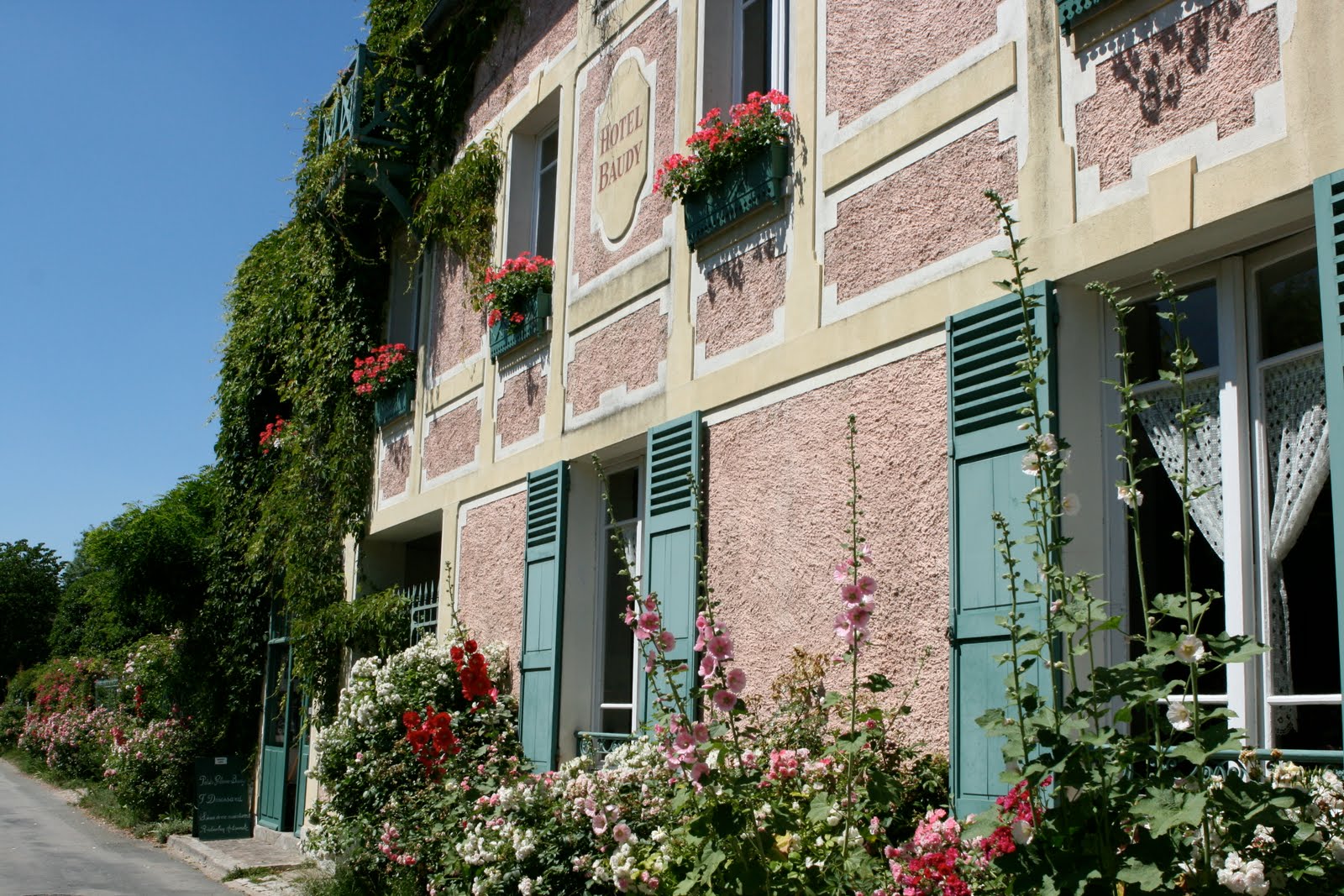 Where Cassatt and Sargent came to stay.


 Monet's home. The rooms of the house are painted in bright yellows, blues and greens, and the walls are covered with framed Japanese prints.A tired camper.A moment of glorious repose.Where Cassatt and Sargent came to stay.
Modernisation of the industry in the 1960s didn’t help. The thirst for “white” bread made from flour enhanced with additives like ascorbic acid and fava bean flour, over kneaded and quickly churned-out without long fermentation, produced a white, but tasteless crumb, and almost spelled the end of a century’s old tradition.
Thankfully, a handful of artisan bakers, millers and experts fought to preserve the integrity of French bread and insure that truly good bread remained a part of French heritage. The State had a hand as well and in 1993 enacted a “French bread law” which stated that “baguettes de tradition” must be mixed, kneaded, leavened and baked on premises, without ever being frozen. They must also be additive-free and can contain only four precious ingredients–wheat flour, water, salt and yeast."
T.G. for baguettes!


 And it tasted mighty fine!


Between 1958 and 1973 Kettle's Yard was the home of Jim and Helen Ede. In the 1920s and 30s Jim had been a curator at the Tate Gallery in London. Thanks to his friendships with artists and other like-minded people, over the years he gathered a remarkable collection, including paintings by Ben and Winifred Nicholson, Alfred Wallis, Christopher Wood, David Jones and Joan Miro, as well as sculptures by Henri Gaudier-Brzeska, Constantin Brancusi, Henry Moore and Barbara Hepworth.
At Kettle's Yard Jim carefully positioned these artworks alongside furniture, glass, ceramics and natural objects, with the aim of creating a harmonic whole. His vision was of a place that should not be: "an art gallery or museum, nor ... simply a collection of works of art reflecting my taste or the taste of a given period. It is, rather, a continuing way of life from these last fifty years, in which stray objects, stones, glass, pictures, sculpture, in light and in space, have been used to make manifest the underlying stability."
Kettle's Yard was originally conceived with students in mind. Jim kept 'open house' every afternoon of term, personally guiding visitors around his home. In 1966 he gave the house and its contents to the University of Cambridge. In 1970, three years before the Edes retired to Edinburgh, the house was extended, and an exhibition gallery added.


 I ate so many scones! Scones are incredible. This one is from Auntie's and was possibly the best scone I've ever eaten. Yum!


